
Medically reviewed by: Akhtar Hossain, M.D., M.S. and Pain Management Specialist. | New Jersey Fentanyl Treatment Guide
Short Answer
Yes. Taking a medication exactly as prescribed does not eliminate the risk of dependence or addiction — it reduces it, but it doesn’t remove it. Certain opioids carry meaningful addiction potential even at prescribed doses, particularly with use beyond a few weeks. This doesn’t mean prescribed pain management is dangerous or should be avoided; it means “I’m following the doctor’s instructions” isn’t, by itself, a guarantee of safety, and it’s worth knowing what actually changes the risk up or down.
Myth vs. Fact
Myth: “If a doctor prescribed it, it can’t be addictive.”
Fact: Prescription status reflects that a medication has an approved medical use and an established (if imperfect) safety profile — not that it carries zero addiction risk. Several commonly prescribed opioids are classified as Schedule II controlled substances specifically because of documented abuse and dependence potential, even at therapeutic doses.
Myth: “Addiction only happens if you take more than prescribed.”
Fact: Physical dependence — and in some cases psychological addiction — can develop at a stable, prescribed dose, especially with longer-duration use. Taking a medication “correctly” affects how dependence develops, not whether it’s possible at all.
Myth: “Short-term prescriptions are safe by default.”
Fact: Duration matters, but it’s not the only variable. Individual risk factors (below) can make even a short course carry more risk for one person than a longer course does for another.
Myth: “If I don’t feel high, I’m not at risk.”
Fact: The euphoric effect that makes opioids misusable and the physical dependence that develops with regular use are related but separate processes. Someone can develop tolerance and withdrawal without ever experiencing or seeking a “high.”
What Actually Changes the Risk
Addiction risk with prescribed medication isn’t uniform — it depends on a combination of factors:
- Duration of use. Risk of dependence rises with continuous use beyond roughly a few weeks for most opioids, though this varies by individual and medication.
- Dose. Higher prescribed doses carry higher dependence risk than lower ones, independent of whether the medication is taken correctly.
- Personal or family history of substance use disorder. This is one of the strongest predictors of risk, including for people taking medication exactly as directed.
- Co-occurring mental health conditions. Anxiety, depression, and trauma history are associated with elevated risk of both misuse and dependence.
- Concurrent use of other CNS depressants. Alcohol, benzodiazepines, or sleep medications taken alongside opioids increase both dependence risk and overdose risk, even within prescribed parameters for each individual medication.
- Age and metabolism. Risk profiles differ across age groups and can affect how quickly tolerance develops.
Medication-Specific Facts
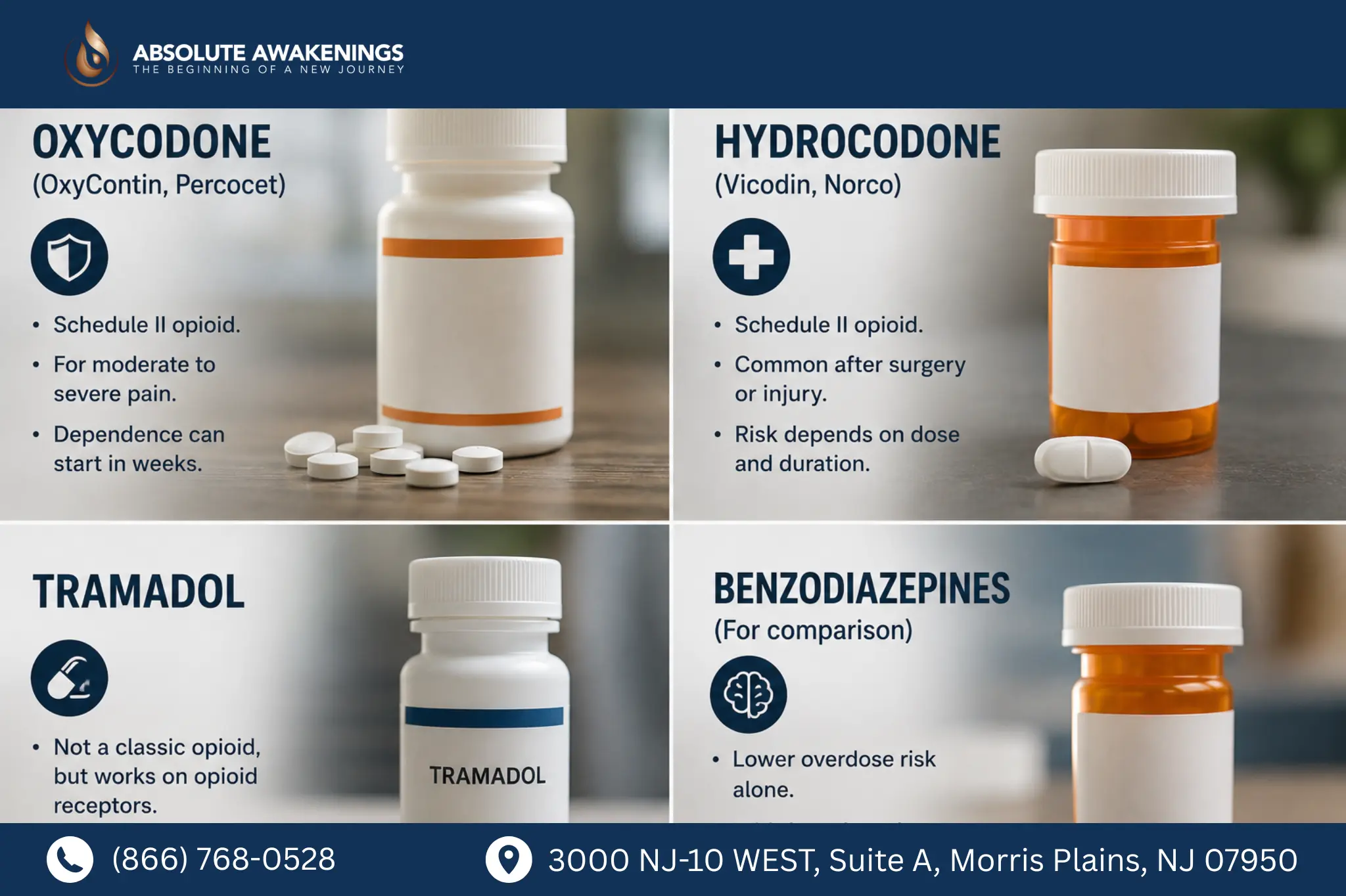
Oxycodone (OxyContin, Percocet) — A Schedule II opioid with recognized high abuse potential. Prescribed for moderate to severe pain. Dependence can develop with regular use measured in weeks, not months, for some patients.
Hydrocodone (Vicodin, Norco) — Also Schedule II. Commonly prescribed after surgery or injury. Addiction potential is comparable to oxycodone; risk is more strongly tied to duration and dose than to which of the two is prescribed.
Tramadol — Often perceived as “milder” because it’s structurally different from classic opioids, but tramadol acts on opioid receptors and carries a real, documented risk of dependence and addiction, particularly with use beyond the short term.
Benzodiazepines (for comparison) — Carry a distinct risk profile: lower overdose risk in isolation than opioids, but a withdrawal process that can be medically dangerous, including seizure risk, if stopped abruptly after regular use — which is a separate reason prescribed benzodiazepine use should never be self-discontinued.
Taking Pain Medication Safely — What Actually Reduces Risk
- Use the lowest effective dose for the shortest necessary duration, in consultation with the prescribing physician — this is a conversation to have proactively, not just if a problem emerges
- Don’t combine with alcohol or other sedating medications without explicit physician guidance
- Ask your prescriber directly about your personal risk factors, including family history — this is a legitimate, common question, not an admission of a problem
- Store medication securely and dispose of unused doses properly
- If a prescription is extending past the original expected timeline, treat that as a cue to check in with the prescriber about the plan going forward, rather than simply continuing to refill
When Proper Use Starts to Shift
There’s a specific moment worth naming: the point where someone notices they’re thinking about the medication schedule more than the pain itself, or that stopping feels harder to imagine than it did at the start. That shift can happen while every dose taken has still technically matched the prescription. It’s not a sign anything was done wrong — it’s a sign it’s worth a conversation with the prescriber about tapering, alternatives, or a broader assessment.
For a fuller picture of what that pattern can look like as it develops, see Signs of Prescription Opioid Addiction.
Frequently Asked Questions (FAQs)
Q. Is it normal to feel anxious when a prescription is running low, even if I’m taking it correctly?
Mild concern about pain returning is common and doesn’t necessarily indicate dependence. Anxiety specifically about the medication itself running low — separate from concern about the underlying condition — is worth mentioning to a prescriber, since it can be an early indicator worth monitoring.
Q. Can I ask my doctor to prescribe something less addictive?
Yes, and it’s a reasonable question to raise directly. Depending on the condition being treated, non-opioid alternatives or lower-risk options may be appropriate — this is worth a direct conversation rather than an assumption in either direction.
Q. If I’ve been on an opioid for months as prescribed, does that mean I’m addicted?
Not necessarily. Extended prescribed use is associated with a higher likelihood of physical dependence, which is a medical condition requiring supervised tapering — but dependence alone is distinct from addiction, which involves compulsive use despite negative consequences. A clinical assessment is the most reliable way to clarify which applies.
Q. Should I stop taking my medication if I’m worried about addiction?
Don’t stop abruptly, particularly with opioids or benzodiazepines — sudden discontinuation can cause withdrawal that ranges from uncomfortable to medically dangerous depending on the medication. Raise the concern with your prescriber, who can plan a safe taper if appropriate.
If You’re Not Sure Where You Stand
This article is written for people who are, understandably, unsure whether their situation applies — not just for people who already recognize a problem. A clinical assessment can answer that question without assuming a particular outcome going in.
Explore related topics in this series:
Learn more about treatment:
Why Absolute Awakenings
Absolute Awakenings provides evidence-based prescription drug addiction treatment in Morris Plains, NJ, serving individuals and families across Morristown, Parsippany, Denville, Randolph, Livingston, and greater Morris, Essex, and Bergen Counties.
Address: 3000 NJ-10, Suite A, Morris Plains, NJ 07950 Phone: (866) 768-0528