


Objective:
To clearly answer how long methadone remains detectable in urine, blood, and saliva; explain the factors that affect detection; and help patients, families, and those in opioid treatment make informed decisions, while supporting admissions and treatment inquiry at Absolute Awakenings in Morris Plains, New Jersey.
Key Takeaways:
- Methadone can be detected in urine for 3 to 14 days after the last dose, and sometimes longer with chronic high-dose use
- Blood tests detect methadone for up to 55 hours; saliva tests for approximately 1 to 2 days
- Methadone has a half-life of 8 to 59 hours, which is far longer than most opioids and explains why it stays detectable well after effects wear off
- Standard opioid panels do not always detect methadone, a specific methadone test is usually required
- Prescribed methadone will produce a positive result and should be disclosed to the testing party
- If methadone use has become difficult to manage or has crossed into misuse, professional support is available at Absolute Awakenings in Morris Plains, NJ, call (866) 768-0528
How Long Does Methadone Show Up in a Drug Test? Urine, Blood, and Saliva Detection Times
Someone enrolled in a methadone maintenance program gets a notification from their employer: drug screening next week. They’ve been taking their prescribed dose every day, following their treatment plan, doing everything right. Now they’re wondering whether methadone will show up and how to handle the result.
This is a real situation many people face, and the answer is not simple. How long does methadone show up in a drug test depends on the type of test, the dose, how long someone has been taking it, and several biological factors. This article lays out the detection windows for urine, blood, and saliva tests, explains why methadone stays in the body longer than most opioids, and covers what to do if methadone use, prescribed or otherwise, has become a problem.
If you or a family member are struggling with opioid use right now, Absolute Awakenings in Morris Plains, New Jersey offers confidential assessments. Call (866) 768-0528 any time, the line is available 24 hours a day.
What Is Methadone and Why Is It Drug Tested?
Methadone is a long-acting synthetic opioid. It is used in two primary clinical contexts: as a pain medication for chronic or severe pain, and as part of medication-assisted treatment (MAT) for opioid use disorder. In MAT programs, methadone reduces cravings and withdrawal symptoms, helping people stabilize without the cycle of repeated highs and crashes associated with short-acting opioids.
Because methadone is a controlled substance, Schedule II under the DEA, it is regularly included in drug testing panels for workplace screenings, legal proceedings, court-mandated monitoring, and clinical compliance checks. It also has potential for misuse, which is why clinics and prescribers monitor its use closely.
Methadone is not the same as most opioids in terms of how the body processes it. Understanding its metabolism explains a lot about why detection windows are longer and more unpredictable than people expect.
For broader context on how opioids are processed and detected, the opiates detection timeline resource on the Absolute Awakenings blog covers the general opioid landscape clearly.
How Long Does Methadone Show Up in a Drug Test? (Quick Answer)
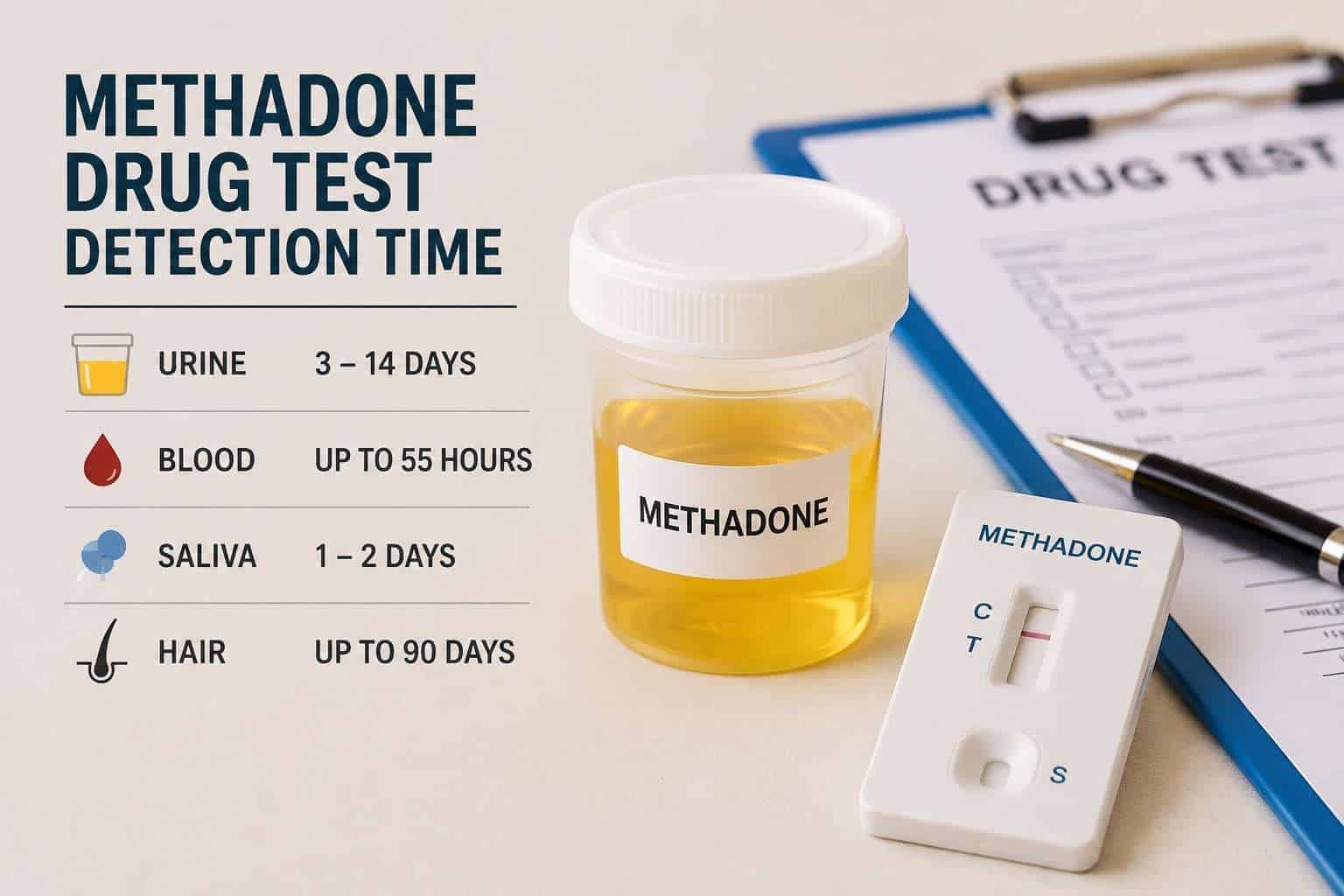
Methadone is detectable in urine for approximately 3 to 14 days after the last dose. In blood, it can be detected for up to 55 hours. Saliva tests typically detect methadone for 1 to 2 days. Hair follicle tests can show methadone use for up to 90 days, though these are less commonly used in routine workplace or clinical settings.
These are estimates. Actual detection times vary by individual. A person who has taken methadone at high doses for several months will test positive far longer than someone who took a single prescribed dose several days ago.
Methadone Detection Times in Urine, Blood, and Saliva
Table 1: Methadone Drug Test Timeline
| Test Type | Estimated Detection Window | What It Detects | Key Limitations |
|---|---|---|---|
| Urine | 3 to 14 days after last dose | Methadone and its metabolite EDDP | Window widens significantly with chronic or high-dose use |
| Blood | Up to 55 hours after last dose | Active methadone in bloodstream | Short window; used mainly in clinical or emergency settings |
| Saliva | 1 to 2 days after last dose | Methadone in oral fluid | Less reliable than urine; not used widely in routine screening |
| Hair | Up to 90 days | Drug metabolites in hair shaft | Requires lab analysis; not standard in most workplace panels |
All times above are estimates based on clinical research and published pharmacokinetic data. Individual results may differ.
Methadone Half-Life vs. Detection Window: What’s the Difference?
The methadone half-life refers to the time it takes for the body to reduce the drug’s concentration in the bloodstream by half. Methadone has a half-life ranging from 8 to 59 hours, with an average of around 24 to 36 hours. This range is unusually wide, even by opioid standards.
Because it takes approximately five half-lives for a drug to leave the system entirely, methadone can theoretically remain present for up to 13 days or longer after the last dose, depending on the individual. This is why how long does methadone show up in a drug test is such a difficult question to answer with a single number.
The detection window is separate from the half-life. Methadone’s pain-relieving effects last roughly 4 to 8 hours per dose, but that does not mean it has left the body. Drug tests detect metabolites long after the effects have worn off. This gap between how long the drug works and how long it remains detectable is what catches many patients off guard.
Factors Affecting Methadone Detection
Several factors affect how long methadone stays in the system and remains detectable on testing:
Table 2: Factors Affecting Methadone Detection
| Factor | How It Affects Detection |
|---|---|
| Dose | Higher doses take longer to metabolize and extend the detection window |
| Frequency of use | Daily use causes accumulation in fatty tissue, significantly extending detection |
| Duration of use | Long-term users retain methadone longer due to tissue buildup |
| Metabolism | Faster metabolism clears the drug sooner; varies significantly between individuals |
| Age | Liver function generally slows with age, extending elimination time |
| Liver health | Methadone is metabolized by the liver; impaired function dramatically slows clearance |
| Kidney function | Excretion relies on kidney filtration; reduced function extends detection |
| Body composition | Methadone is lipophilic, it stores in fatty tissue. Higher body fat can prolong elimination |
| Other medications | Certain drugs affect liver enzymes that process methadone, altering its metabolism |
| Test sensitivity | Higher-sensitivity tests detect lower concentrations and produce positive results for longer |
No single factor determines the outcome. The interaction between these variables is why two people taking the same dose can produce very different test results.
Can Prescribed Methadone Cause a Positive Drug Test?

Yes, it can. Prescribed methadone will appear on a methadone-specific drug test regardless of whether it is taken exactly as directed. This is not a sign of misuse, it is a predictable pharmacological outcome.
One important detail: standard urine drug screens that test for opioids are typically designed to detect heroin, morphine, and codeine. They do not reliably detect methadone. A specific methadone panel must be ordered for the drug to appear. This is why knowing what panel is being used matters.
If you are taking prescribed methadone and facing a drug test, disclose it to the testing administrator in advance and provide documentation from your prescribing physician or treatment program. Most workplace and legal panels have procedures for handling disclosed prescription medications.
For comparison, here is how methadone differs from other opioids that are more commonly screened. For example, hydrocodone urine detection is typically 1 to 3 days, far shorter than the window for methadone, largely because hydrocodone has a much shorter half-life.
Methadone Withdrawal and Medical Risks
Methadone withdrawal is medically significant and should not be managed without clinical supervision. Because methadone is long-acting, withdrawal does not begin immediately after the last dose. Symptoms often start 24 to 36 hours after the last dose and can persist for weeks, sometimes longer, depending on how long someone has been taking it.
Common methadone withdrawal symptoms include muscle aches, sweating, insomnia, anxiety, gastrointestinal distress, and intense cravings. The methadone withdrawal timeline is typically slower and more prolonged than withdrawal from short-acting opioids like heroin or oxycodone, but the discomfort can be severe.
Do not stop taking prescribed methadone abruptly without consulting your prescribing physician or treatment program. Sudden discontinuation carries real medical risk, including severe withdrawal, relapse, and in some cases, overdose from returning to street opioid use after tolerance has dropped.
Emergency warning signs that require calling 911 include: difficulty breathing, loss of consciousness, extreme confusion, unresponsive pupils, or any suspected overdose.
When Methadone Use May Require Professional Support
Prescribed methadone, taken as directed under clinical supervision, is a legitimate and effective treatment for opioid use disorder. The challenge arises when the medication itself begins to be misused, taken in higher doses than prescribed, obtained outside a treatment program, combined with alcohol or benzodiazepines, or used primarily to get high rather than to stabilize.
Signs that methadone use may have become problematic include: taking more than prescribed, using without a prescription, mixing with other central nervous system depressants, continued use of other opioids alongside methadone, and inability to reduce or stop despite wanting to.
Family members may notice behavioral changes, sedation, or withdrawal symptoms between doses. If you recognize these patterns in yourself or someone you care about, speaking with a treatment professional is the right next step.
Get Confidential Opioid Treatment Help
Struggling with methadone or opioid use? Absolute Awakenings offers 24/7 confidential drug treatment in New Jersey. Reach out to our compassionate team now.
Opioid Treatment Near Morris Plains, New Jersey
Absolute Awakenings is located at 3000 NJ-10, Morris Plains, NJ 07950, and serves patients across New Jersey including Morristown, Parsippany, East Hanover, Newark, Jersey City, and surrounding communities. For those searching for methadone treatment near me in northern or central New Jersey, the facility is accessible and accepts patients through a straightforward admissions process.
The treatment team at Absolute Awakenings provides evidence-based care for opioid use disorder, including medication-assisted treatment, partial hospitalization, intensive outpatient programming, and outpatient services, with dual-diagnosis support for patients managing co-occurring mental health conditions.
What Happens During Assessment and Admissions at Absolute Awakenings?
The admissions process at Absolute Awakenings is designed to be clear and low-barrier. Here is how it typically works:
- Initial contact, Call (866) 768-0528 or reach out via the contact page. Calls are confidential.
- Screening conversation, An admissions counselor asks about substance use history, current situation, and any immediate concerns.
- Insurance verification, The team checks your benefits and explains what is covered before any commitment is made.
- Clinical assessment, A clinical professional evaluates your needs and recommends the appropriate level of care.
- Admission, Once a plan is agreed upon, admission is coordinated as quickly as possible, sometimes same day.
Questions worth asking at this stage include: What level of care is recommended and why? Does my insurance cover this program? What happens if I need detox before treatment? How long will the program last?
If you are ready to take that step, explore treatment programs at Absolute Awakenings to understand the options available.
Treatment Costs and Insurance Coverage
Most major insurance plans cover at least a portion of substance use treatment. Absolute Awakenings works with a range of private insurance providers and can help verify benefits before admission. Medicaid is another option for eligible patients, covering detox and treatment programs for those who qualify.
Cost should not be the reason someone delays getting help. The admissions team can walk through financial options, verify insurance, and identify whether any coverage gaps exist. Verify your insurance benefits here before making a decision.
A middle step worth taking before any commitment: call (866) 768-0528 to ask specific questions about your coverage. The call is free and confidential.
FAQ
What is the methadone detection time in urine?
Methadone is generally detectable in urine for 3 to 14 days after the last dose. Chronic users taking high doses may test positive beyond that window. Detection time varies by individual metabolism, dose, and how long the person has been taking methadone.
How long is methadone detectable in blood?
Methadone and its primary metabolite EDDP can be detected in blood for up to 55 hours after the last dose. Blood testing is not the standard method for routine methadone screening and is more commonly used in emergency or clinical settings.
What is the methadone saliva test detection time?
Saliva tests can detect methadone for approximately 1 to 2 days after the last dose. Methadone can appear in saliva as soon as 30 minutes after ingestion. Saliva testing is less commonly used for methadone than urine testing.
Does prescribed methadone appear on a drug test?
Yes. If a drug panel includes a specific methadone test, prescribed methadone will produce a positive result. Standard opioid panels targeting morphine and codeine do not always detect methadone. Always disclose your prescription to the testing administrator and bring documentation from your prescriber.
What is the methadone half-life?
Methadone has a half-life of 8 to 59 hours, with an average around 24 to 36 hours. The wide range reflects how differently individuals metabolize the drug based on liver function, body composition, other medications, and duration of use. This long half-life is the main reason methadone remains detectable in the system longer than most opioids.
Why does methadone remain detectable for so long?
Methadone is lipophilic, meaning it stores in fatty tissue and is released slowly back into the bloodstream. Combined with its long half-life, this creates a prolonged detection window that can extend well beyond the point where the drug’s effects are felt.
What is the methadone withdrawal timeline?
Methadone withdrawal typically begins 24 to 36 hours after the last dose, later than withdrawal from short-acting opioids. Symptoms peak around 72 to 96 hours and can persist for two to four weeks or longer. Never stop prescribed methadone suddenly, always consult your prescribing provider first.
Does insurance cover methadone addiction treatment in New Jersey?
Most private insurance plans and Medicaid cover substance use treatment, including programs that address opioid use disorder. Coverage specifics vary by plan. The admissions team at Absolute Awakenings can verify your benefits confidentially before you commit to anything.
Can a family member contact admissions on behalf of someone struggling?
Yes. Family members are encouraged to call (866) 768-0528 to ask questions, get information about available programs, and understand what options exist. The call is confidential and carries no obligation. Guidance is available on how to support a loved one through the decision to enter treatment.
Is there opioid treatment near Morris Plains, New Jersey?
Absolute Awakenings is located in Morris Plains, NJ, and serves patients from Morristown, Parsippany, East Hanover, Newark, Jersey City, and surrounding New Jersey communities. The admissions line is open 24 hours a day at (866) 768-0528.
Understanding Your Situation Is the First Step
Knowing how long does methadone show up in a drug test is useful information, but it rarely solves the underlying concern. If the question comes from anxiety about an upcoming employment screen, talking to your prescribing provider about documentation is the right move. If it comes from a growing awareness that methadone use has shifted from treatment into dependency, that awareness matters more than the detection window.
Absolute Awakenings provides confidential assessments, opioid treatment programs, insurance verification, and support for families navigating these decisions. The facility is in Morris Plains, New Jersey, and the admissions line is available around the clock.
Contact Absolute Awakenings today, or call (866) 768-0528 to speak with someone now. There is no obligation, and the conversation is confidential.
Medical Review Statement: This article is intended for educational purposes only. It does not replace medical advice, diagnosis, treatment, or emergency care. Detection times presented are estimates based on published clinical data and may vary significantly by individual. Anyone taking prescribed methadone should consult their treating physician before making any changes to their medication. This article should be reviewed by a qualified medical professional before publication.