
Medically reviewed by: Akhtar Hossain, M.D., M.S. and Pain Management Specialist.
Quick Answer
There is rarely a single moment that makes the decision obvious — which is exactly why so many people wait longer than they should. If prescription drug use is affecting your health, relationships, work, or sense of control, that’s already enough reason to seek an assessment. You don’t need to hit rock bottom, lose something irreplaceable, or reach certainty about the word “addiction” before reaching out. Below are 12 concrete signs that indicate it’s time to take the next step, along with what that step actually involves.
Look in NIH article why Prescription Drug Detox is important
Why This Question Is Hard to Answer for Yourself
The person closest to the problem is usually the last to see its full scope. Tolerance builds gradually. Justifications accumulate one reasonable-sounding explanation at a time. And because the medication was often legitimately prescribed, there’s rarely a clear line that was crossed — just a slow drift from managing a condition to managing the absence of the medication. That’s normal, and it’s precisely why an outside clinical perspective is often what actually clarifies things, rather than more self-monitoring.
This is also why lists like the one below tend to be more useful than introspection alone. It’s easier to compare your situation against a concrete, external description than to ask yourself the abstract question “do I have a problem?” — a question that’s surprisingly easy to answer “not yet” to indefinitely, regardless of what’s actually happening.
Know more about : Prescription Drug treatment in NJ
12 Signs It’s Time for Prescription Drug Rehab
1. You’ve tried to cut back or stop and couldn’t. Attempting to reduce use — even successfully for a few days — followed by returning to prior levels is one of the clearest indicators of dependence that’s moved beyond simple habit.
2. You’re taking more than prescribed, or running out early. This is rarely a one-time event by the point someone notices the pattern in themselves. If refills are consistently needed before the scheduled date, the dose has effectively escalated beyond what was prescribed.
3. You’ve sought prescriptions from more than one provider. Seeking parallel prescriptions, whether from multiple doctors or urgent care visits for similar complaints, indicates the current supply is not meeting the level of use.
4. You experience withdrawal symptoms between doses. Sweating, nausea, anxiety, or physical discomfort that resolves after taking the medication is a sign of physical dependence requiring medical management, not something to push through alone.
5. You’ve continued using after the original medical reason resolved. Once the injury has healed or the prescription’s original purpose has passed, continued use is no longer about the condition — it’s about the medication itself.
6. Obtaining or using the medication has become a daily preoccupation. Checking your supply, calculating timing, or planning your day around access to the medication signals that use has moved from background to central.
7. You’ve experienced a close call — a near-overdose, dangerous combination, or blackout. A close call is not a warning to be more careful next time. It’s a data point that the current level of use already carries life-threatening risk.
8. Relationships have become strained by your use or by hiding it. Secrecy, defensiveness, or conflict with family and friends specifically about the medication is a sign the behavior has outpaced what feels comfortable to be transparent about.
9. Work or academic performance has declined. Missed deadlines, absences, or a noticeable drop in performance tied to use — or to withdrawal between doses — indicates the medication’s impact has extended beyond its original medical purpose.
10. You’ve combined the medication with alcohol or other substances. Combining opioids or benzodiazepines with alcohol or other sedatives substantially increases overdose risk and is a strong indicator that use is no longer being managed with medical caution.
11. You feel unable to function normally without it. Needing the medication just to feel “normal” — rather than to manage the original condition — marks the shift from medical use to dependence requiring clinical support to safely address.
12. You’ve thought about seeking help, more than once. If the thought “maybe I should look into this” has come up more than once, that repetition is itself meaningful information — not something to wait on until it becomes more urgent.
How Many Signs Does It Take?
There’s no minimum threshold, and waiting for a specific number is itself a form of delay. One or two of these signs, present consistently over weeks, is enough reason for a clinical assessment. You don’t need all 12 to qualify for help, and you don’t need certainty about a diagnosis before making a call — an assessment exists to provide that clarity, not to require it upfront.
It’s also worth naming the reverse mistake: treating this list as a pass/fail test to argue your way out of. A common pattern is counting signs, finding a technicality for why one or two don’t quite apply, and using that as reason to postpone. If you found yourself doing that while reading, that instinct is itself worth paying attention to.
Levels of Care: Matching Treatment to Where You Are
Not everyone who needs help needs the same intensity of treatment. The right level of care depends on the severity of use, medical risk during withdrawal, and what’s realistic given work, family, and support systems — not on how “bad” the situation feels compared to someone else’s.
- Medical detox — for anyone with physical dependence where stopping carries withdrawal risk, particularly with opioids or benzodiazepines. Typically the first step when it’s needed, lasting several days under medical supervision.
- Inpatient/residential treatment — full-time structured care, appropriate when use has significantly disrupted daily functioning or when a lower level of support has already been tried without success.
- Outpatient treatment — structured therapy and support while continuing to live at home and, in many cases, continuing to work — appropriate for less severe patterns or as a step-down after detox or residential care.
A clinical assessment is what determines the right starting point — not a guess made from the outside, and not something you need to figure out before calling.
What Happens If You Wait
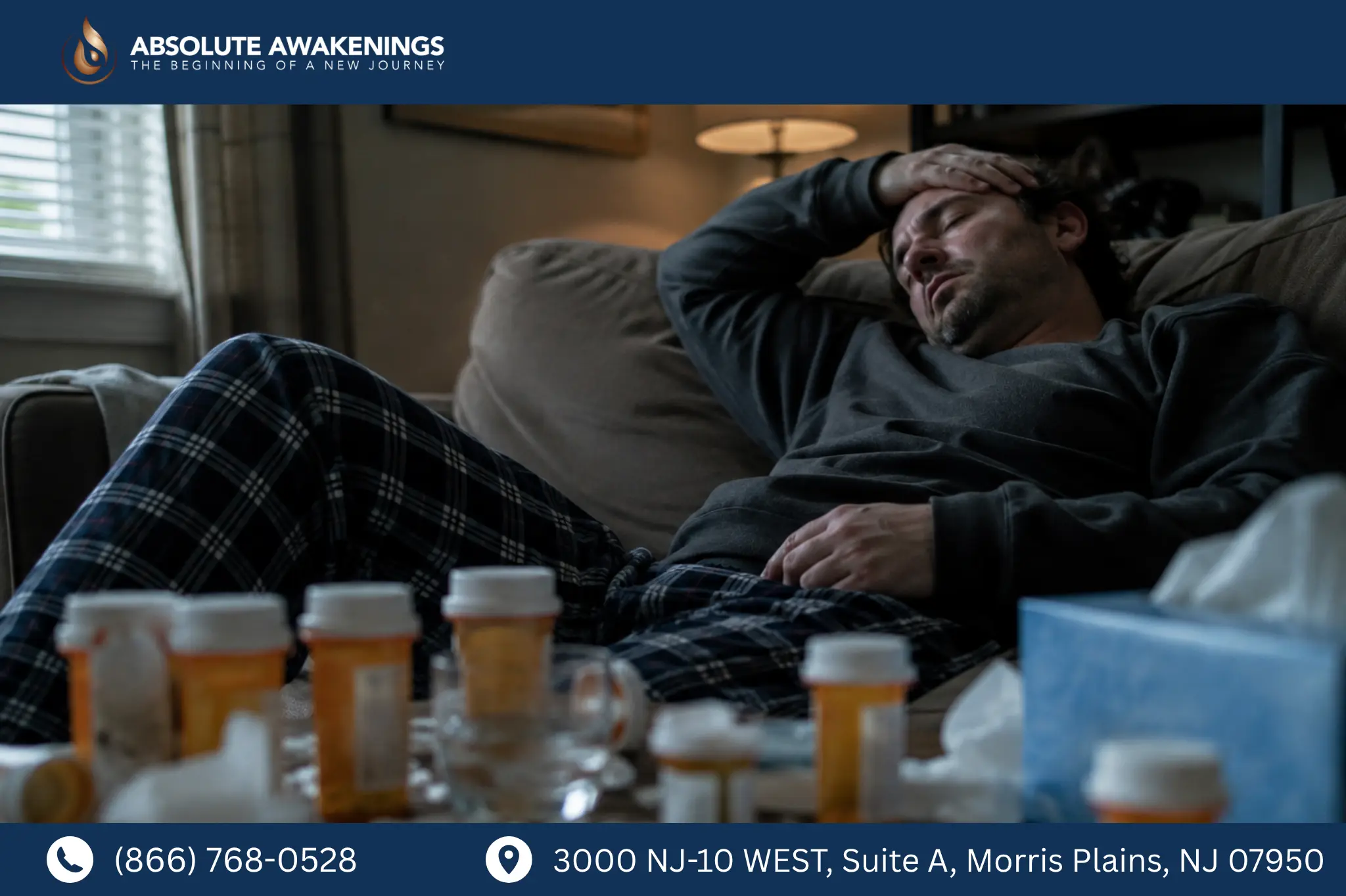
Prescription drug misuse rarely plateaus on its own. Left unaddressed, it commonly follows one of a few paths: continued escalation of dose, a transition to obtaining medication outside the prescription system — which carries its own serious risks, including exposure to counterfeit pills — or a medical crisis that forces the issue. None of these paths are better than starting treatment now, and all of them are harder to recover from than the step you’re weighing today.
There’s also a quieter cost to waiting that doesn’t show up on any of the 12 signs above: the accumulating weight of managing the secrecy itself. Many people describe the mental load of hiding or minimizing use as, by the end, nearly as exhausting as the substance use it was covering for.
What Treatment Actually Looks Like
Many people delay reaching out because they picture treatment as more disruptive or dramatic than it typically is. In practice:
- Assessment. A confidential clinical conversation about your use, health history, and goals — this alone doesn’t commit you to anything.
- Medical detox, if needed. Supervised withdrawal management for medications where stopping abruptly carries risk, such as opioids and benzodiazepines.
- Structured treatment. Individual and group therapy addressing both the physical dependence and what drove the pattern in the first place.
- A plan for continuing care. Treatment doesn’t end at discharge — ongoing support is what makes recovery durable.
The first phone call is an information-gathering conversation, not a commitment. Most people find that the step they’d been dreading turns out to be far less daunting than the uncertainty they’d been living with.
Frequently Asked Questions (FAQs)
Q. Do I need to be using illegally to qualify for rehab?
No. A significant share of people who enter prescription drug treatment began with a legitimate prescription. Treatment addresses the pattern of use and its impact, not whether a law was broken.
Q. Will I have to stop my prescribed medication immediately?
Not necessarily, and not unsupervised. Medical detox is designed specifically to manage discontinuation safely, including tapering protocols where abrupt stopping would be dangerous.
Q. What if I’m not sure it’s “bad enough” for rehab? This is one of the most common hesitations, and it’s rarely an accurate self-assessment.
An assessment exists precisely to answer that question — you don’t need to pre-diagnose yourself before calling.
Q. How do I bring this up with a family member I’m worried about?
Focus on specific behaviors you’ve observed rather than labels, choose a calm moment rather than a crisis, and consider offering to help make the first call together rather than asking them to do it alone.
Q. What if I’ve been through treatment before and it didn’t work? A previous treatment experience that didn’t lead to lasting recovery is information, not a verdict.
Different levels of care, treatment approaches, or timing can matter more than people expect — an assessment can help identify what might need to be different this time rather than assuming the outcome will repeat.
Take the Next Step
Waiting for more certainty, a worse moment, or a clearer sign is, itself, the pattern this article is describing. If even a few of the 12 signs above sound familiar, that’s a reasonable basis to reach out — not proof you have to figure it out on your own first.
Our admissions team is available to answer questions confidentially, explain treatment options, and verify insurance — with no obligation.
Call (866) 768-0528, or verify your insurance and start the admissions process online.
Learn more about treatment:
Why Absolute Awakenings
Absolute Awakenings provides evidence-based prescription drug rehab in Morris Plains, NJ, serving individuals and families across Morristown, Parsippany, Denville, Randolph, Livingston, and greater Morris, Essex, and Bergen Counties.
Address: 3000 NJ-10, Suite A, Morris Plains, NJ 07950 Phone: (866) 768-0528