
Medically reviewed by: Akhtar Hossain, M.D., M.S. and Pain Management Specialist. | New Jersey Fentanyl Treatment Guide
Quick Answer
Fentanyl is not just a stronger version of prescription opioids — it belongs in a different risk category entirely. Fentanyl is a synthetic opioid estimated to be up to 50 times more potent than heroin and up to 100 times more potent than morphine, meaning a dose too small to see with the naked eye can be fatal. Prescription opioids like oxycodone and hydrocodone carry real addiction risk, but they’re manufactured under regulated, consistent dosing. Illicit fentanyl is not — and that inconsistency, more than potency alone, is what makes it the leading driver of overdose deaths in the United States today.
Two Different Kinds of Danger
It’s tempting to rank opioids on a single scale from “less dangerous” to “more dangerous.” That scale exists, but potency and danger aren’t actually the same measurement, and conflating them is where a lot of the real-world risk gets missed.
Prescription opioids are dangerous primarily because of dosing escalation — the gradual increase in tolerance and dose over time. Fentanyl is dangerous primarily because of dosing unpredictability — when it’s obtained illicitly, there is no way to know how much is actually in what you’re taking. A person can develop a opioid use disorder over months or years with a prescription opioid. A single exposure to illicitly-manufactured fentanyl can be fatal the first time.
Potency Comparison
| Substance | Relative Potency (vs. Morphine) | Primary Source |
|---|---|---|
| Morphine | 1x (baseline) | Prescription, medical use |
| Oxycodone | ~1.5x | Prescription |
| Hydrocodone | ~1x | Prescription |
| Heroin | ~2–5x | Illicit |
| Fentanyl | Up to 100x | Prescription (medical settings) and illicit manufacturing |
This table is doing less work than it looks like it’s doing. Relative potency tells you how strong a substance is milligram-for-milligram — it does not tell you how dangerous a real-world dose is, because that depends entirely on how precisely the dose was measured. A pharmaceutical fentanyl patch, administered in a hospital, is calibrated with medical precision. A counterfeit pill sold as “Percocet” that actually contains illicit fentanyl has no such calibration — and that gap is where the overdose risk actually lives.
Where Prescription Opioids Fit
Oxycodone, hydrocodone, and similar medications are Schedule II controlled substances, prescribed for legitimate pain management, and manufactured with regulated, consistent dosing. The risk with prescription opioids is almost entirely about pattern of use over time — tolerance, escalation, and the transition from medical need to compulsive use. Someone taking a prescribed, pharmacy-dispensed oxycodone tablet knows, with a high degree of confidence, exactly how much of the drug they’re taking.
That confidence is precisely what disappears once opioid use moves outside the prescription system.
This is also why the treatment approach for prescription opioid misuse looks different from a purely illicit-drug intervention. A clinician treating prescription opioid use disorder is working with a known substance, a known dose history, and a predictable withdrawal profile — which allows for a carefully staged medical taper. Someone whose use has extended into the illicit supply, potentially including fentanyl exposure, requires a different level of medical caution during detox, because the substances actually consumed may not match what the person believes they’ve been taking.
Where Fentanyl Fits — And Why the Line Isn’t Always Clear
Fentanyl has two very different identities, and confusing them is a common and consequential mistake.
Pharmaceutical fentanyl is a legitimate, FDA-approved medication used in hospitals and for severe pain management, typically as a patch, lozenge, or injectable under strict medical supervision.
Illicitly manufactured fentanyl is produced outside any regulatory system and is increasingly used to lace counterfeit pills made to visually resemble oxycodone, Xanax, Adderall, and other prescription medications. This is the single most important fact in this entire article: a pill that looks exactly like a prescription medication can contain a lethal dose of fentanyl, with no visible, textural, or taste-based way to tell the difference.
This is the direct bridge between prescription opioid misuse and fentanyl risk. Someone who begins seeking pills outside a legitimate prescription — even believing they’re purchasing a familiar medication like oxycodone — has no reliable way of knowing whether what they’ve obtained is a genuine pharmaceutical product or a counterfeit containing fentanyl.
Know more here: Can Someone Survive a Fentanyl Overdose?
How Prescription Opioid Use Can Lead to Fentanyl Exposure
This progression is well documented and worth stating plainly: a meaningful share of fentanyl-involved overdoses begin with a prescription opioid, not with a decision to use fentanyl. The pathway typically looks like this:
- Legitimate prescription for pain management
- Tolerance develops; the original prescription no longer covers the need
- When a new prescription isn’t available, the person seeks pills outside the medical system
- Pills obtained this way may be counterfeit and contain illicit fentanyl — often without the buyer’s knowledge
The person may believe, right up until the moment of overdose, that they are taking the same medication they were originally prescribed. This is why fentanyl awareness belongs inside a prescription drug addiction conversation, not just an illicit-drug conversation — the two risks are connected, not separate.
Overdose Risk: What Actually Changes
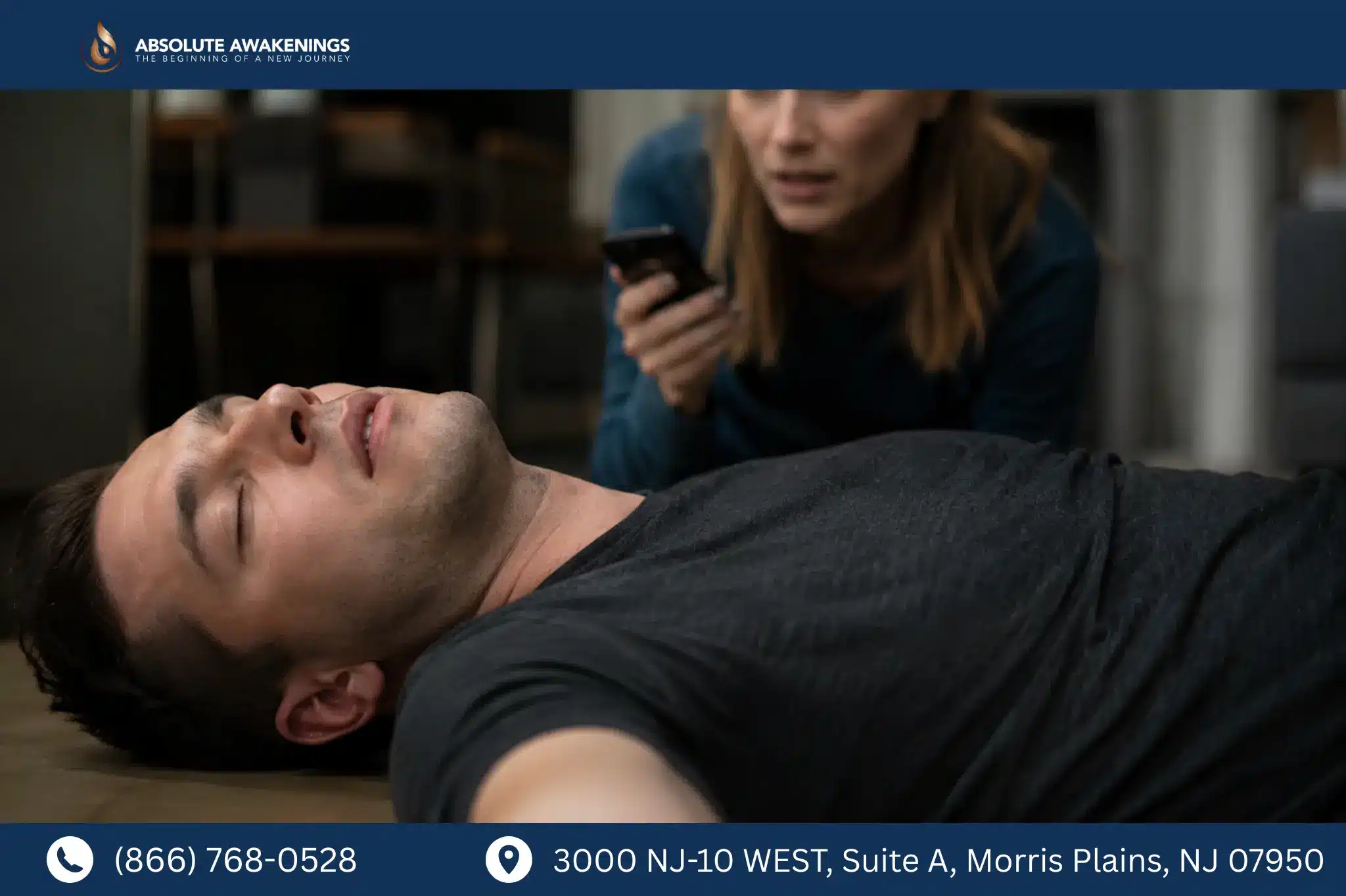
- Onset speed. Fentanyl’s effects, including respiratory depression, can begin within minutes — faster than many prescription opioids, leaving a narrower window for intervention.
- Naloxone response. Naloxone (Narcan®) can reverse opioid overdoses including fentanyl, but fentanyl overdoses may require multiple doses, and continued medical monitoring is essential even after apparent revival.
- Combination risk. Mixing any opioid with alcohol, benzodiazepines, or other sedatives multiplies overdose risk — this is true for prescription opioids and fentanyl alike, but the margin for error is dramatically smaller with fentanyl.
- Unknown dosing. This is the risk factor that doesn’t exist with a pharmacy-dispensed prescription and is the primary reason illicit fentanyl accounts for a disproportionate share of overdose deaths relative to its prevalence.
What Families Need to Know
If someone in your life has been misusing a prescription opioid, the fentanyl risk isn’t a separate, future concern — it’s already relevant now. Any pill obtained outside a licensed pharmacy should be treated as a potential fentanyl exposure risk, regardless of what it’s claimed to be or how convincing it looks. Fentanyl test strips can detect its presence in a substance, though they aren’t foolproof given how unevenly fentanyl can be distributed within a single batch of counterfeit pills — a strip testing negative on one part of a pill doesn’t guarantee the entire pill is fentanyl-free.
Keeping naloxone accessible is a harm-reduction step, not an endorsement of continued use. Families sometimes hesitate to keep naloxone in the home out of a sense that doing so accepts or normalizes the behavior. Clinically, the opposite framing is more accurate: naloxone is a safeguard against an outcome that has nothing to do with whether the underlying addiction gets treated — it exists to keep someone alive long enough to reach treatment in the first place.
It’s also worth being direct about what this article is not saying. Not everyone who misuses a prescription opioid will encounter fentanyl, and not every overdose involves it. The point isn’t to suggest that every instance of prescription drug misuse is one step from a fentanyl-related death — it’s that the line between “prescription opioid problem” and “fentanyl exposure risk” is thinner than most families assume, and that thinness is exactly why early intervention on the prescription side matters as much as it does.
Frequently Asked Questions (FAQs)
Q. Is fentanyl always more dangerous than oxycodone?
Pharmaceutical fentanyl, administered under medical supervision, is a controlled and monitored medication. Illicitly manufactured fentanyl is significantly more dangerous than oxycodone because of its potency combined with the complete absence of dosing consistency or quality control.
Q. Can you overdose on fentanyl without knowing you took it?
Yes. This is one of the most important facts for anyone using pills obtained outside a pharmacy. Counterfeit pills can contain fentanyl without any detectable difference in appearance, taste, or texture from the medication they’re designed to mimic.
Q. How much fentanyl is dangerous?
Because illicit fentanyl is not produced with pharmaceutical-grade consistency, there is no way to reliably predict a “safe” amount in a given counterfeit pill or substance — this unpredictability, not a specific quantity, is the core danger.
Q. Does someone need to be a heavy drug user to be at risk from fentanyl?
No. Because fentanyl contamination occurs in counterfeit pills that resemble common prescription medications, even occasional or first-time non-pharmacy use of a pill believed to be oxycodone, Xanax, or a similar medication carries risk.
Q. If a loved one is misusing a prescription opioid, should I assume fentanyl is already involved?
Not necessarily, but it’s the safer assumption to act on rather than the riskier one to dismiss. Treat any non-pharmacy-sourced pill as a potential fentanyl exposure until proven otherwise, and let that assumption inform urgency around treatment — even if it turns out not to be the case, the cost of that caution is low, and the cost of the opposite assumption being wrong is not.
Q. Does treatment differ if fentanyl exposure is suspected alongside prescription opioid misuse?
Yes. Medical detox protocols account for what’s actually present in a person’s system, not just what they were originally prescribed — which is why an honest, non-judgmental clinical intake conversation about all substances used, including anything obtained outside a pharmacy, is a safety issue as much as a treatment-planning one.
The Bottom Line
These two risks aren’t in competition with each other — they’re stages of the same problem. Prescription opioid misuse creates the conditions under which someone might seek pills outside the medical system; fentanyl contamination is what makes that specific decision potentially fatal in a way it wasn’t a decade ago. Treating prescription opioid misuse early isn’t just about addressing dependence — it’s about preventing exposure to a substance where there may not be a second chance to intervene.
From our fentanyl cluster:
Learn more about treatment:
- Fentanyl Addiction Treatment Program
- Prescription Drug Rehab Programs
- Admissions & Insurance Verification
Why Absolute Awakenings?
Absolute Awakenings provides evidence-based treatment for both prescription opioid and fentanyl addiction in Morris Plains, NJ, serving individuals and families across Morristown, Parsippany, Denville, Randolph, Livingston, and greater Morris, Essex, and Bergen Counties.
Address: 3000 NJ-10, Suite A, Morris Plains, NJ 07950 Phone: (866) 768-0528