



Objective
This blog explains what happens when someone stops Adderall after regular use. It covers common adderall withdrawal symptoms, how long Adderall stays in your system, what the detox and recovery timeline can look like, and what treatment and relapse prevention may involve.
Key Takeaways
- Adderall is a stimulant medicine that contains amphetamine salts, and regular use can lead to physical dependence in some people.
- When the drug is stopped, people may feel tired, low, irritable, hungry, or unable to sleep well because the body and brain are adjusting.
- There is no single medication approved by the FDA specifically for stimulant withdrawal, so care usually focuses on monitoring, rest, support, therapy, and treatment for mood or sleep issues when needed.
- Adderall leaves the body much faster than recovery happens. The drug’s half-life is about 10 to 13 hours in adults, but symptoms can last days or weeks.
- In 2023, about 3.9 million people aged 12 or older in the United States reported past-year prescription stimulant misuse, which shows this is a real public health issue and not a rare problem.
Stopping Adderall can feel harder than many people expect. Some people think the drug leaves the body, and that is the end of it. In real life, that is not how it usually feels. The body may clear the drug in a day or two, but the brain can take much longer to settle down. That is why people often feel confused when the hardest part is not the first missed dose, but the days that come after it.
This is also why shame does not help. A person is not weak because they feel tired, low, or emotionally off after stopping. Withdrawal is a real response to a real change in brain chemistry. At Absolute Awakenings, the healthier way to look at it is simple: understand what is happening, get support early, and take recovery one step at a time.
What Adderall Does In The Body
Adderall is a prescription stimulant made from mixed amphetamine salts. It is commonly prescribed for ADHD and can also affect alertness, energy, attention, appetite, heart rate, and sleep.
When someone takes it regularly, especially at higher doses or outside medical guidance, the brain starts adjusting to that stimulation. Over time, the body may depend on the drug to feel focused, awake, or emotionally steady. That does not mean every person who takes Adderall as prescribed will become dependent, but dependence can happen, and misuse raises that risk.
Why Withdrawal Happens
Withdrawal happens because the brain has been pushed in one direction for a while and now has to rebalance. Stimulants increase alertness and activity. When they are removed, the brain often swings the other way for a period of time. SAMHSA and the ASAM/AAAP stimulant guideline both describe stimulant withdrawal as a real clinical issue that can involve mood changes, sleep disruption, fatigue, and cravings.
This is why a person may feel “crashed” after stopping. The body is not just missing the drug. It is trying to function without the extra push it got used to.
Adderall Withdrawal Symptoms
Adderall withdrawal symptoms can vary, but several patterns show up often in stimulant withdrawal. The most common problems are:
- Extreme tiredness or low energy
- Depression or a heavy low mood
- Anxiety or agitation
- Trouble sleeping, or sleeping much more than usual
- Increased appetite
- Poor concentration or brain fog
- Irritability
- Strong cravings to use again
Some people mainly feel exhausted. Others feel emotionally raw. Some feel both at once. It is also common for motivation to drop sharply for a while. That can scare people, especially if they expected to feel better quickly.
A second important point is that mental health symptoms deserve attention. The ASAM/AAAP guideline notes that stimulant withdrawal can include depression and other psychiatric symptoms, and clinicians are advised to assess patients closely.
Get Help Through Adderall Withdrawal Today
Feeling stuck, exhausted, or overwhelmed after stopping Adderall? Talk to experts who understand your struggle and guide you step by step.
How Long Does Adderall Stay In Your System
A lot of people ask, how long does adderall stay in your system. The FDA label for Adderall XR reports a mean elimination half-life in adults of about 10 hours for d-amphetamine and about 13 hours for l-amphetamine. A drug is not fully cleared after one half-life, so it generally takes longer than that for most of it to leave the body.
That means Adderall may be mostly out of the body within a couple of days for many adults, though timing can vary with dose, formulation, metabolism, age, and kidney function. But this is where people get confused: the drug leaving the body is not the same as the brain being recovered. Withdrawal and the recovery timeline can continue after the drug itself is gone.
Adderall Detox And Recovery Timeline
There is no perfect schedule that fits everyone, but many people move through a rough pattern.
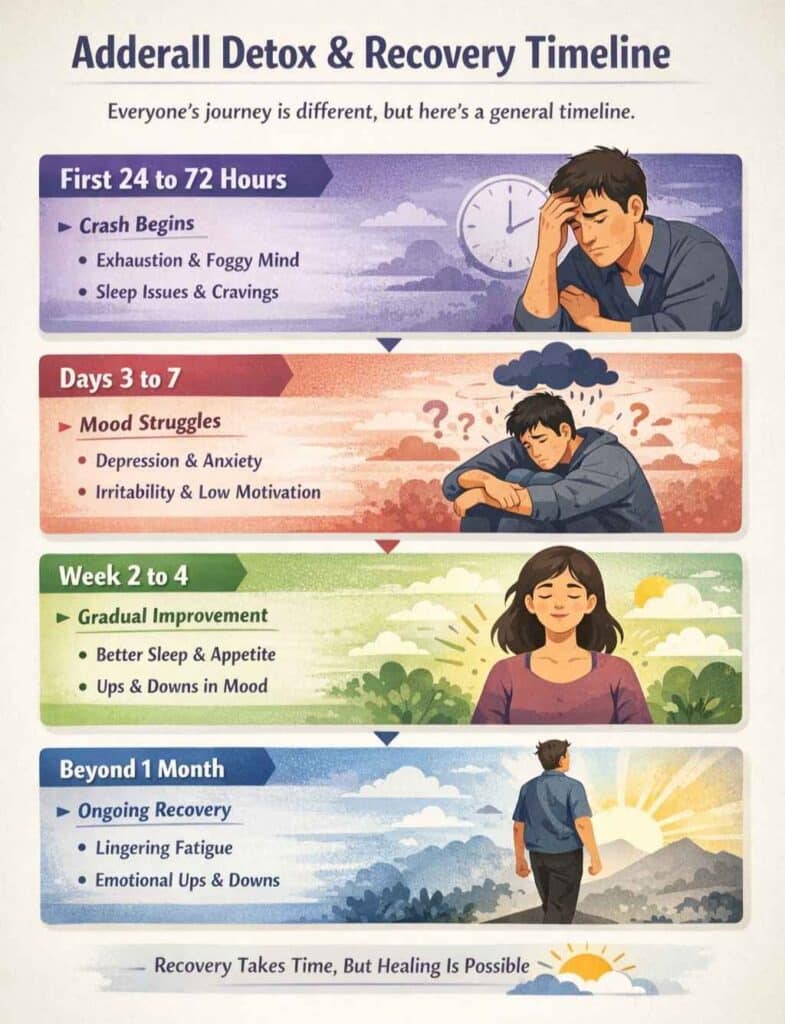
First 24 To 72 Hours
This is often when the crash starts. People may feel drained, foggy, emotionally flat, or unusually hungry. Sleep may swing in either direction. Some people sleep for long stretches. Others feel restless and sleep poorly. Cravings can start here, too.
Days 3 To 7
This can be the hardest part for mood. Fatigue may still be strong. Low motivation, irritability, sadness, and anxiety can all be more noticeable. A person may start wondering if something is wrong because they still do not feel normal. This stage often takes patience.
Week 2 Through Week 4
For many people, sleep and appetite begin to settle. Energy may improve slowly, not all at once. Focus can still feel weaker than usual. Mood may be better some days and rough on others. This uneven pattern is common.
Beyond The First Month
Some people feel much better by this point. Others still deal with low drive, poor concentration, or mood swings for longer. SAMHSA describes the idea of protracted withdrawal for some substances, meaning symptoms can outlast the early phase. Stimulant recovery can also take time, especially when use was heavy or long-standing.
Medical Risks And When To Get Help
Adderall withdrawal is usually not described the same way as alcohol or benzodiazepine withdrawal, which can be medically dangerous in a different way. But that does not mean it should be brushed off. The biggest risks are often emotional and behavioral, not dramatic physical collapse. SAMHSA and the ASAM/AAAP guideline both emphasize monitoring for depression, agitation, and safety concerns during stimulant withdrawal.
A person should get prompt professional help if they have:
- Severe depression
- Intense anxiety or panic
- Confusion or worsening mental state
- Inability to function at all
- Thoughts of self-harm or fear that they may not stay safe
That is one reason supervised detox or structured treatment can be so useful. It gives people support during the part that can feel most unstable.
Adderall Dependence Treatment
Adderall dependence treatment usually does not rely on one single “cure” medication. SAMHSA notes that there is currently no FDA-approved medication specifically for stimulant use disorder, so treatment often centers on behavioral care, clinical monitoring, and support for related symptoms.
Treatment may include:
- Detox support and monitoring
- Sleep and nutrition support
- Therapy for cravings, stress, and mood
- Treatment for co-occurring anxiety or depression
- Outpatient or residential care, depending on severity
This is where Absolute Awakenings fits naturally into the conversation. The goal is not just to get through the first crash. The goal is to help the person stabilize and then keep going.
Therapy And Relapse Prevention
People do better when treatment goes beyond detox. Therapy matters because stimulant use is often tied to stress, burnout, pressure, emotional pain, or habits that have built up over time.
SAMHSA highlights behavioral approaches for stimulant use disorders, including structured counseling models such as the Matrix Model, along with recovery support and relapse prevention planning.
Helpful recovery steps often include:
- Building a simple daily routine
- Protecting sleep
- Eating regular meals
- Cutting off easy access to pills
- Learning personal triggers
- Staying connected to therapy or support groups
- Having a plan for cravings before they hit
Relapse prevention is usually not about willpower alone. It is about structure. It is about knowing what tends to pull a person back and putting real support around those moments.
Conclusion
Stopping Adderall can bring a real crash, and that crash can feel physical, mental, and emotional all at once. The drug may leave the body fairly quickly, but the recovery timeline can last longer because the brain still needs time to adjust. That is why adderall withdrawal symptoms should be taken seriously, even when they are expected.
The good news is that recovery is possible, and people do get better. With the right support, adderall dependence treatment can help someone move from detox into steadier healing, stronger routines, and better relapse prevention. Absolute Awakenings can be part of that process by giving people a place to understand what is happening and start moving forward without shame.
FAQs
What Are The Most Common Adderall Withdrawal Symptoms?
The most common adderall withdrawal symptoms include fatigue, depression, anxiety, irritability, increased appetite, sleep problems, cravings, and poor concentration.
How Long Does Adderall Stay In Your System?
The FDA label reports adult half-lives of about 10 hours for d-amphetamine and about 13 hours for l-amphetamine, so the drug is often largely cleared within a couple of days, though this varies by person.
Is Adderall Withdrawal Dangerous?
It is not usually described the same way as withdrawal from alcohol or benzodiazepines, but it can still be serious because of depression, cravings, and other mental health symptoms.
What Does Adderall Dependence Treatment Usually Involve?
Adderall dependence treatment often includes detox support, therapy, monitoring, relapse prevention planning, and treatment for related mood or sleep problems. There is no FDA-approved medication specifically for stimulant use disorder at this time.
How Common Is Prescription Stimulant Misuse?
SAMHSA’s 2023 NSDUH reported that about 3.9 million people aged 12 or older had past-year prescription stimulant misuse, and about 1.7 million had a past-year prescription stimulant use disorder.