

Objective
Help people in New Jersey and their families understand the clinical relationship between alcohol and depression, identify which condition is driving the cycle, and take the next step toward integrated treatment at Absolute Awakenings.
Key Takeaways
- Alcohol and depression have a bidirectional relationship, meaning each one makes the other worse over time
- Alcohol is a central nervous system depressant that depletes serotonin and dopamine, directly worsening mood
- Depression often leads people to drink as self-medication, which temporarily dulls symptoms but deepens the condition long term
- Drinking alcohol while on antidepressants reduces the medication’s effectiveness and can create dangerous interactions
- Alcohol-induced depression can develop independently of any prior psychiatric history after sustained heavy drinking
- Treating only one condition while leaving the other unaddressed is the most common reason people relapse
- Absolute Awakenings in New Jersey offers integrated dual diagnosis treatment for alcoholism and depression
People rarely sit down one day and decide to drink their way into a depressive disorder. It usually starts smaller than that. A few drinks after a hard week. Something that reliably takes the edge off when nothing else does. A habit that builds so gradually that by the time someone notices the pattern, both the drinking and the depression are already well established.
Alcohol and depression are so commonly found together that clinicians treat the combination as its own category of concern. They interact, reinforce, and conceal each other in ways that make both harder to treat in isolation. The person who is drinking to manage depression rarely sees the depression getting worse. The person whose drinking has created a depressive disorder rarely connects their mood to the alcohol.
Breaking that cycle requires understanding how it works. If you or someone close to you is caught between alcohol and depression and not finding a way out, Absolute Awakenings treats both conditions together at our New Jersey facility. Call us at (866) 768-0528 or read on to understand the connection between alcoholism and depression before taking the next step.
The Alcohol and Depression Cycle: How It Actually Starts
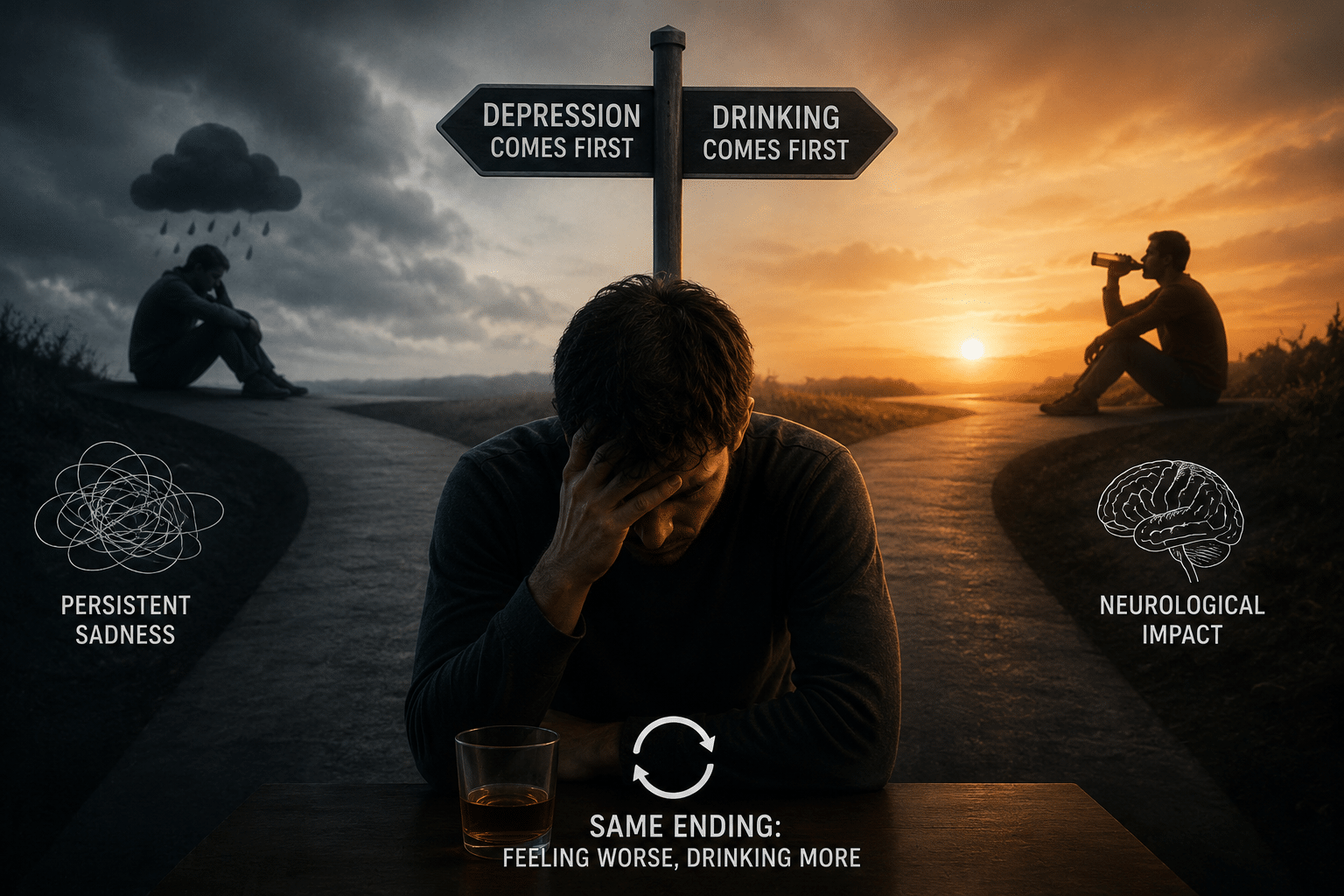
The cycle between alcohol and depression rarely has a clean starting point. For some people, depression comes first. They feel persistently low, lose interest in things that used to matter, and find that a drink or two in the evening makes the weight of that feel more manageable. It works. So it continues.
For others, the drinking comes first. A period of heavy use, maybe related to stress, grief, or just a social environment where drinking was constant, gradually shifts their baseline mood downward. By the time they notice they feel depressed, the alcohol has already been doing neurological damage for months.
Both paths lead to the same place: a person who is drinking more than they want to and feeling worse than they did before they started. The substance is no longer providing relief. It is maintaining a state of dysfunction that neither medication nor willpower alone is enough to resolve.
Does Alcohol Cause Depression, or Does Depression Cause Drinking?
The honest clinical answer is that it runs both ways, and trying to determine which came first is less useful than understanding how they interact right now.
That said, the research is clear on one point: alcohol directly causes depressive symptoms through its effect on brain chemistry, regardless of whether a person had depression beforehand. Someone who had no history of depression before drinking heavily can develop a full depressive disorder as a direct result of sustained alcohol use. That is alcohol-induced depression, and it is distinct from a primary depressive disorder that existed before drinking began.
Conversely, people with untreated depression are significantly more likely to develop alcohol use disorder. Depression creates an emotional environment where substances feel like relief. The brain learns that association quickly, and what starts as self-medication becomes physical and psychological dependence.
The table below shows how the direction of the relationship shapes what treatment needs to look like:
| Scenario | What It Suggests Clinically |
|---|---|
| Depression existed before heavy drinking began | Primary depressive disorder, alcohol used as self-medication |
| Depression developed after sustained heavy drinking | Likely alcohol-induced depression, may resolve partially with sobriety |
| Both appeared around the same time | Co-occurring disorders requiring integrated dual diagnosis treatment |
| Depression worsens significantly after stopping alcohol | Withdrawal-related mood disruption, requires clinical monitoring |
What Alcoholism and Depression Do to the Brain
Alcoholism and depression both affect the same brain systems. That overlap is part of why the combination is so clinically difficult to separate.
Alcohol suppresses the central nervous system. Short-term, that suppression produces calm and reduces social anxiety. Long-term, chronic alcohol use depletes serotonin and dopamine production, the two neurotransmitters most directly tied to mood regulation, motivation, and emotional resilience. The brain adapts to the presence of alcohol by scaling back its own chemical production. Remove the alcohol, and the deficit becomes visible. That is where the persistent low mood, anhedonia, and emotional blunting that characterize alcoholism and depression come from.
Depression, independently, also disrupts these same pathways. Two conditions degrading the same systems simultaneously explains why people struggling with both feel so stuck. The neurological baseline for feeling anything close to normal becomes increasingly hard to reach without the substance, even as the substance is the thing making the depression worse.
The Alcohol-Induced Depression Timeline
Not everyone who drinks heavily develops a depressive disorder, but for those who do, the alcohol-induced depression timeline tends to follow a recognizable pattern.
Weeks 1 to 4 of heavy daily drinking: Mood begins to shift. Sleep quality declines. Irritability increases. The person may attribute this to stress or circumstance rather than the alcohol.
Months 1 to 3: Energy drops. Motivation decreases. Social withdrawal begins. Drinking continues partly because it remains the most accessible thing that temporarily improves mood, even if only for a couple of hours.
Months 3 to 12 and beyond: Clinical depressive symptoms are now consistent and present even on days without drinking. The mood no longer lifts reliably after alcohol. The person may now meet diagnostic criteria for major depressive disorder alongside alcohol use disorder.
After stopping alcohol: For many people, depressive symptoms worsen significantly in the first one to three weeks of sobriety. This is partly withdrawal and partly the brain recalibrating without its chemical crutch. For people with alcohol-induced depression, symptoms often improve meaningfully after two to four weeks of sustained sobriety. For people with a primary depressive disorder, sobriety alone is unlikely to resolve the depression, and psychiatric treatment remains necessary.
Get Help for Alcohol and Depression Starting Today
Struggling with alcohol and depression? Speak confidentially with our admissions team, verify insurance, and explore treatment options today.
Drinking Alcohol While on Antidepressants: What Actually Happens
A significant number of people in treatment for alcohol use disorder are also on antidepressants, often prescribed before the extent of their drinking was fully known. The interaction matters clinically.
Drinking alcohol while on antidepressants creates several problems:
- Alcohol blunts or blocks the therapeutic effect of most antidepressants, meaning the medication is not working as intended
- The combination can intensify sedation, impair judgment, and increase fall or accident risk
- With MAOIs specifically, the combination can trigger dangerous spikes in blood pressure
- Alcohol worsens the underlying depression the medication is trying to treat, creating a futile cycle where the prescription never gets a fair chance to work
Many people are surprised to learn their antidepressant has not been working because they assumed the drinking was too minimal to matter. In most cases, even moderate regular drinking is enough to interfere with how these medications function. This is not a moral judgment. It is pharmacology.
Can Alcohol Cause Anxiety and Depression at the Same Time?
Yes, and it frequently does. Anxiety and depression are the two most common co-occurring conditions with alcohol use disorder, and alcohol contributes to both through the same neurological mechanisms.
The short-term anxiolytic effect of alcohol, the way it quiets a racing mind or loosens social inhibition, is real. That is exactly why people with anxiety disorders are at elevated risk of developing alcohol dependence. The brain learns that alcohol reduces anxiety, and it reaches for that solution repeatedly.
Long-term, alcohol dysregulates the GABA system, the brain’s primary anxiety-management pathway. The result is rebound anxiety that is often far worse than the original anxiety the person was drinking to manage. Add in the depressive effects of sustained alcohol use on serotonin and dopamine, and it becomes clear why so many people present with both conditions simultaneously.
The question of whether someone can have alcohol cause anxiety and depression at the same time is almost beside the point in treatment. The more relevant question is whether both conditions are being addressed within the same program.
How to Break the Cycle: What Treatment for Depression and Alcohol Looks Like

Breaking the cycle between depression and alcohol requires treating both simultaneously within the same clinical program. Sequential treatment, addressing the alcohol first and then circling back to the depression later, leaves the primary driver of relapse in place.
At Absolute Awakenings in New Jersey, treatment for co-occurring alcohol use disorder and depression starts with a full clinical assessment that maps both conditions and their relationship to each other. From there, the program is built around integrated care.
Detox Placement: For people who are physically dependent on alcohol, medically supervised detox is the first step. Mood is monitored throughout because alcohol withdrawal can sharply worsen depressive and anxiety symptoms in the first days of sobriety. Absolute Awakenings coordinates detox placement to ensure this phase is handled safely.
Partial Hospitalization (PHP): After detox, PHP provides intensive daily treatment while allowing patients to return to a sober living or home environment each evening. Psychiatric care, individual therapy, and group work run alongside each other within the same structure. Our PHP program in New Jersey is built to handle the complexity of dual diagnosis cases.
Intensive Outpatient (IOP): For people stepping down from PHP or those who need structured support without full-day programming, our IOP alcohol program in New Jersey continues the integrated treatment model with several hours of clinical programming per week.
Trauma-Informed Care: A significant proportion of people with co-occurring alcoholism and depression have underlying trauma that neither condition developed independently of. Absolute Awakenings integrates trauma-informed care throughout the treatment model rather than treating trauma as a separate track.
Cognitive Behavioral Therapy (CBT): CBT is one of the most evidence-supported therapies for both depression and alcohol use disorder. It directly addresses the thought patterns and behavioral responses that maintain both conditions. Our clinical team uses CBT as a core component of treatment for people dealing with depression and alcohol together.
Recovery Capital is a proprietary framework developed at Absolute Awakenings that builds the internal and external resources a person needs to sustain recovery, including housing, relationships, employment, and mental health, because sobriety without a functioning life structure rarely holds.
Medical Note: This article is for informational purposes only and does not constitute medical advice. Depression and alcohol use disorder are both serious medical conditions that require professional evaluation and treatment. Do not stop taking antidepressants or other psychiatric medications without consulting a licensed physician. If you or someone you know is in crisis or experiencing suicidal thoughts, call 988 or go to the nearest emergency room immediately. For questions about dual diagnosis treatment in New Jersey, contact Absolute Awakenings directly at (866) 768-0528.
Frequently Asked Questions
Does alcohol cause depression, or am I just feeling low because I drink too much?
Both can be true at once. Alcohol directly disrupts serotonin and dopamine production, which causes depressive symptoms independent of any prior mental health history. If you have been drinking heavily for months and feel persistently low, flat, or hopeless, alcohol is very likely contributing to that, regardless of whether you had depression before you started drinking.
How long does alcohol-induced depression last after stopping?
For most people, mood begins to stabilize within two to four weeks of stopping alcohol. For those with a primary depressive disorder that predated heavy drinking, the depression will not resolve on its own after sobriety and requires separate psychiatric treatment. A clinical assessment helps distinguish between the two.
Can I take antidepressants if I am still drinking?
The medication will not work as intended while you are drinking regularly. Alcohol blocks or reduces the therapeutic effect of most antidepressants, and the combination intensifies sedation and impairs judgment. The honest answer is that antidepressants require sobriety to function properly, which is one more reason treating both conditions together makes clinical sense.
What does integrated treatment for alcohol and depression actually involve?
It means both conditions are assessed and treated within the same program, by a clinical team that communicates directly, rather than sending a person to separate providers who may not share information. This includes psychiatric evaluation, medication management, individual and group therapy, relapse prevention planning that accounts for mood triggers, and aftercare that maintains both the sobriety and the mental health work.
Does insurance cover treatment for co-occurring alcohol use disorder and depression in New Jersey?
Most major insurance plans cover dual diagnosis treatment as a medically necessary service. Absolute Awakenings works with most major providers. The fastest way to confirm your coverage is to verify your benefits online or call our team at (866) 768-0528 and we will run your insurance before you make any commitments.
I have tried getting sober before and the depression made it impossible to stay that way. What is different about dual diagnosis treatment?
What you experienced is exactly what happens when only the substance use is treated and the depression is left unaddressed. The depression becomes unbearable in early sobriety and relapse follows. Integrated dual diagnosis treatment addresses both conditions simultaneously so that sobriety does not have to be maintained against the weight of an untreated psychiatric condition.
Can anxiety and depression both be treated alongside alcohol use disorder in the same program?
Yes. Co-occurring anxiety, depression, and alcohol use disorder are among the most common combinations seen in treatment. Absolute Awakenings has extensive clinical experience with this specific presentation and builds treatment plans that address all three within the same integrated program.
Conclusion
The relationship between alcohol and depression is not a personal failing. It is a clinical pattern with a clear mechanism, and it responds to treatment when both conditions are addressed properly and at the same time.
Absolute Awakenings in New Jersey provides integrated treatment for alcoholism and depression through every level of care from detox placement through intensive outpatient. The program is built around treating the whole person, not just the most visible problem.
Call us at (866) 768-0528 or verify your insurance online today. You can also contact our admissions team directly for a confidential conversation about what the right level of care looks like for your situation.