
Medically reviewed by: Akhtar Hossain, M.D., M.S. and Pain Management Specialist. | New Jersey Fentanyl Treatment Guide
Quick Answer
Prescription drug addiction is the compulsive use of medication — most often opioids, benzodiazepines, or stimulants — despite negative consequences to health, relationships, or daily functioning. It can develop even when someone takes a medication exactly as prescribed, because physical dependence and psychological addiction are not the same thing and can occur together or separately. Warning signs include needing more of the drug for the same effect, running out of prescriptions early, “doctor shopping,” and continuing use after the original medical reason has resolved. Treatment typically combines medical detox, therapy, and long-term relapse prevention, and outcomes improve significantly with early intervention.
What Is Prescription Drug Addiction?
Prescription drug addiction occurs when a medication that was originally prescribed for a legitimate medical purpose — pain, anxiety, ADHD, insomnia — is used in a way that causes harm, and the person continues using it despite that harm. This is different from dependence, which is a physical adaptation the body makes to a substance and can occur with medications taken exactly as directed.
Dependence vs. addiction:
| Dependence | Addiction | |
|---|---|---|
| What it is | The body adapts to a substance, requiring it to avoid withdrawal | Compulsive use despite negative consequences |
| Can happen with proper use? | Yes — common with long-term opioid or benzodiazepine prescriptions | Not defined by proper use — defined by behavior and impact |
| Withdrawal symptoms | Present | Often present, but not the defining feature |
| Loss of control over use | Not necessarily | Central feature |
According to the National Institute on Drug Abuse, physical dependence can develop within weeks on some prescription opioids, well before any signs of compulsive or harmful use appear — which is part of why patients and families are often caught off guard.
The Three Classes of Prescription Drugs Most Commonly Misused
Opioids (oxycodone, hydrocodone, morphine, tramadol) — prescribed for moderate to severe pain. Highest overdose risk of the three classes, particularly when combined with other central nervous system depressants.
Benzodiazepines (Xanax, Valium, Ativan, Klonopin) — prescribed for anxiety, panic disorders, and insomnia. Withdrawal can be medically dangerous, including risk of seizure, which is why benzodiazepine detox should always be medically supervised and never attempted alone.
Stimulants (Adderall, Ritalin, Vyvanse) — prescribed for ADHD and narcolepsy. Often misused for focus, weight loss, or energy, particularly among students and professionals — a population that frequently doesn’t identify with the word “addiction.”
How Prescription Drug Addiction Develops
There isn’t one single path. Three patterns show up most often in treatment settings:
- Legitimate prescription → tolerance → escalation. A patient is prescribed medication for a real medical need. Over time, the same dose stops working as well (tolerance), and either the patient or, less often, the prescriber increases the dose. Use continues past the point the original condition required it.
- Borrowed or diverted use. Someone uses a medication prescribed to a family member or friend — often starting with a single instance (“I had a headache and took one of my mom’s Percocet”) that establishes a pattern.
- Recreational initiation. The medication is used from the outset for its psychoactive effects rather than a medical purpose, frequently obtained without a prescription.
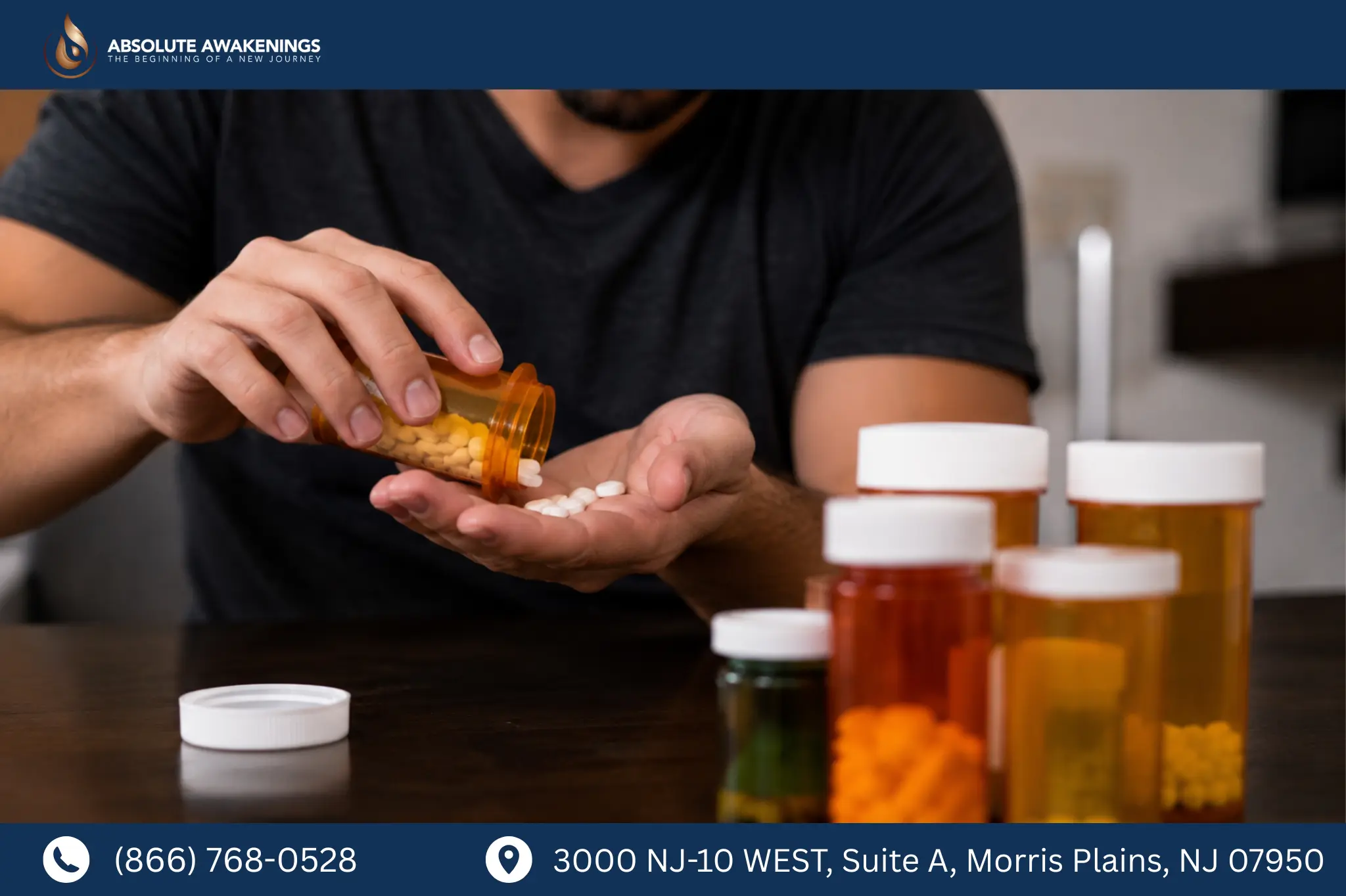
Signs of Prescription Drug Addiction
Behavioural signs:
- Taking a higher dose or more frequent doses than prescribed
- Running out of medication before the refill date
- “Doctor shopping” — seeking prescriptions from multiple providers
- Becoming anxious, irritable, or preoccupied when supply is low
- Continuing to use after the medical reason for the prescription has ended
- Withdrawing from work, family, or social activities
Physical signs:
- Drowsiness, slowed breathing, or confusion (opioids)
- Slurred speech, poor coordination (benzodiazepines)
- Rapid weight loss, insomnia, elevated heart rate (stimulants)
- Withdrawal symptoms between doses
Psychological signs:
- Denial that use is a problem, especially when the medication is legally prescribed
- Guilt or secrecy around use
- Using the medication to cope with emotions rather than its original medical purpose
If you’re unsure whether what you’re seeing in yourself or a loved one crosses from proper use into addiction, that uncertainty is itself worth discussing with a clinician — you don’t need to be certain before reaching out.
Risks of Untreated Prescription Drug Addiction
- Overdose, particularly with opioids and when combined with alcohol or other depressants
- Progression to illicit drugs. A significant portion of individuals in treatment for heroin or fentanyl use report that their opioid use began with a legitimate prescription
- Medically dangerous withdrawal, especially with benzodiazepines, where unsupervised discontinuation can cause seizures
- Organ damage from long-term high-dose use, particularly with acetaminophen-combination opioids
- Deteriorating mental health, including worsening anxiety and depression once the medication’s initial effect wears off
Treatment for Prescription Drug Addiction
Effective treatment addresses both the physical dependence and the underlying reasons use became compulsive.
| Stage | What Happens | Typical Duration |
|---|---|---|
| Assessment | Clinical evaluation of substance use history, medical needs, and co-occurring mental health conditions | 1 day |
| Medical Detox | Supervised withdrawal management, medication as needed | 3–10 days, varies by substance |
| Structured Treatment | Individual therapy, group therapy, family involvement, relapse prevention planning | Weeks to months |
| Continuing Care | Outpatient support, alumni programs, ongoing relapse prevention | Ongoing |
Because withdrawal from benzodiazepines and high-dose opioids can carry real medical risk, detox should always be medically supervised rather than attempted at home.
What Families Say
“We didn’t think it counted as addiction because the prescription had our name on it. That’s what kept us from calling for almost a year.” — family member of a former client, shared with permission, identifying details withheld
If part of what’s holding you back from reaching out is the sense that “it’s just a prescription, so it doesn’t count” — that’s one of the most common things families tell us after they’ve already gone through treatment, looking back.
Frequently Asked Questions (FAQs)
Q. Can you become addicted to a prescription drug even if you take it exactly as prescribed?
Yes. Physical dependence can develop from proper use of certain medications, particularly opioids and benzodiazepines taken over an extended period. Dependence alone isn’t the same as addiction, but it can be a precursor, and it still requires medical supervision to discontinue safely.
Q. What’s the difference between prescription drug abuse and addiction?
Abuse generally refers to using a medication outside of how it was prescribed — a higher dose, someone else’s prescription, or a non-medical purpose. Addiction is a diagnosable condition marked by compulsive use despite negative consequences, and not everyone who misuses a prescription meets that threshold, though misuse is a significant risk factor.
Q. Is prescription drug rehab different from illicit drug rehab?
The clinical treatment process is largely similar — assessment, detox if needed, therapy, and continuing care — but prescription drug treatment often includes additional focus on the original medical condition the drug was treating, so it can be managed safely without the medication going forward.
Q. How do I talk to a family member about their prescription drug use?
Focus on specific behaviors you’ve observed rather than labels, avoid confrontation during moments of use or withdrawal, and consider involving a clinician or interventionist if the conversation has been attempted before without success.
When to Seek Help
Early intervention is strongly associated with better long-term outcomes. You don’t need to wait for a crisis, and you don’t need to be certain the word “addiction” applies — a clinical assessment can help clarify that.
Explore related topics in this series:
Learn more about treatment:
Why Absolute Awakenings
Absolute Awakenings provides evidence-based prescription drug addiction treatment in Morris Plains, NJ, serving individuals and families across Morristown, Parsippany, Denville, Randolph, Livingston, and greater Morris, Essex, and Bergen Counties.
Address: 3000 NJ-10, Suite A, Morris Plains, NJ 07950 Phone: (866) 768-0528